
Heat Staking vs. Hot Plate Welding: Which Is Right for Your Application?
At Vimalssonic, guiding you from design feasibility to foolproof assembly.
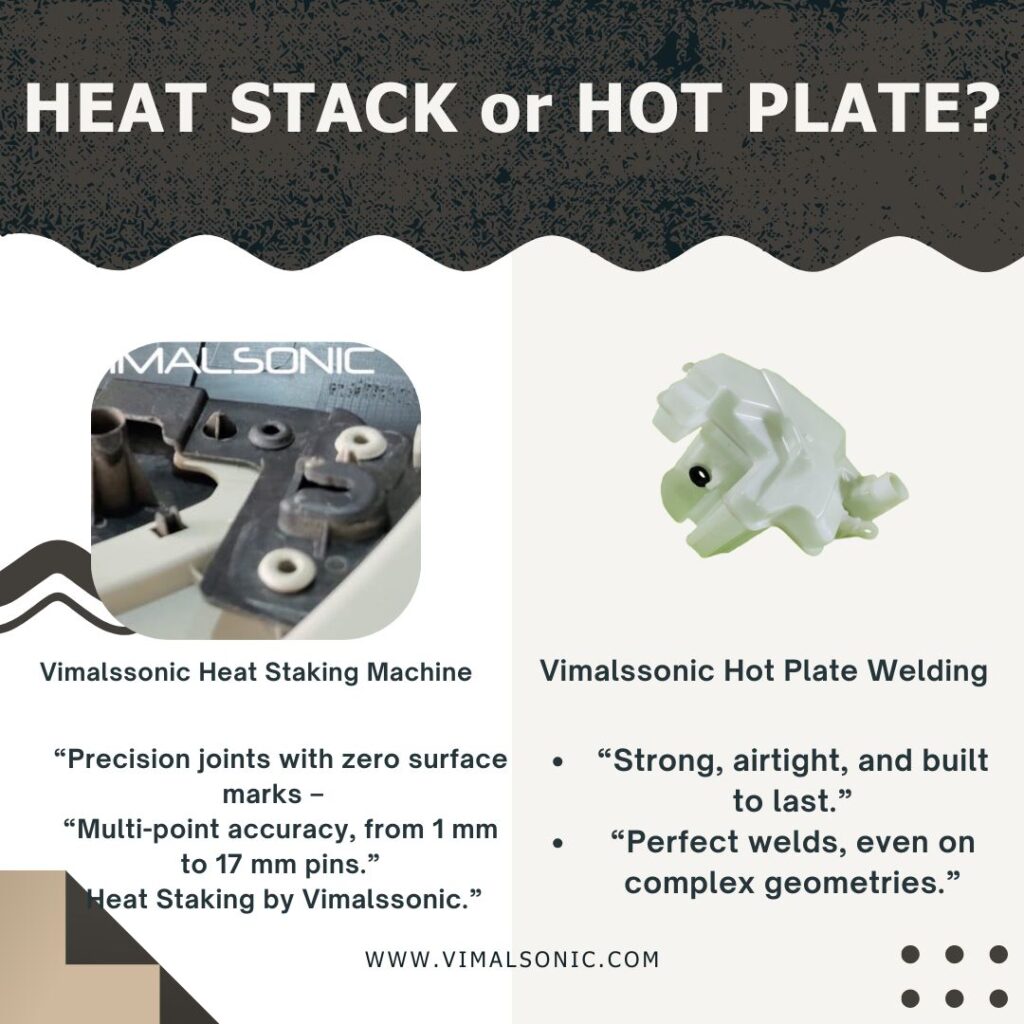
Section 1: Product Highlights Heat Staking vs. Hot Plate Welding
| Feature | Heat Staking Machine | Hot Plate Welding Machine |
|---|---|---|
| Pin Size Range | 1 mm to 17 mm multipoint staking | N/A |
| Precision | ±0.05 mm repeatability | ±2°C uniform heating |
| Control | Servo-driven force & temperature | Integrated temperature control |
| Design | Modular tooling for complex geometries | Custom tooling for multi-cavity welds |
| Welding Area | Localized | Up to 600 mm × 400 mm |
| Automation Ready | Standard | Robot and conveyor integrated |
| Material Compatibility | Plastic-to-plastic and plastic-to-metal | Complex thermoplastics including glass-filled |
Section 2: Performance Metrics Heat Staking vs. Hot Plate Welding
| Metric | Heat Staking | Hot Plate Welding |
|---|---|---|
| Cycle Time | 3–12 seconds | 12–30 seconds |
| Energy Consumption | Low (localized heating) | Higher (entire platen heated) |
| Strength | Strong, localized joints, zero surface impression | Hermetic, high-strength welds |
| Maintenance | Low | Periodic platen cleaning |
| Defect Rates | <1% | <1% |
Section 3: Application Areas
-
Heat Staking:
Automotive dashboards, interior trims, infotainment housings, PCB mounting, display modules, control panels, switches
Best for localized plastic-metal/plastic joints -
Hot Plate Welding:
Automotive air intake manifolds, fluid reservoirs, bumpers, medical containers, filters, battery housings, enclosures
Best for large thermoplastic components requiring hermetic seals
Section 4: Why Vimalssonic for Heat Staking vs. Hot Plate Welding?
-
17+ years of experience with end-to-end guidance: design feasibility, custom engineering, trials, and installation.
-
2,000+ automation solutions deployed.
-
Tailor-made machines with multipoint staking up to 69 points per cycle.
-
Zero surface impression guarantee.
-
Localized services for faster support and spares.
-
Proven ROI improvements: faster cycles, low defects, extended tooling life.
Section 5: Who Should Choose Heat Staking vs. Hot Plate Welding?
-
Engineers & Designers: For product reliability and material compatibility.
-
Plant Managers: For improved productivity and uptime.
-
Procurement Teams: To maximize ROI, cost competitiveness, and service reliability.
Whether it’s precision multipoint heat staking or robust hot plate welding, Vimalssonic ensures the right technology fit for your application.
👉 Ready to evaluate which process suits your product?
Let’s connect and discuss your requirement today.
